Book a demo
The platform · version 5.4

Everything it does,
with no dressing up

This is not a three-bullet brochure. It is the list of what an operator does every day and where they do it inside WispControl. If you are after something specific, it is in the index.

01 · Administration

Customers, contracts
and the money

The module that gets used the most and shows the least when it works. A customer has contracts, a contract has services, and every service knows what it is billed, when, with which tax and to which account.

  • CustomersA record with contracts, services, invoices, payments, tickets, notifications and documents. Search by name, tax ID, phone, IP or device serial number.
  • ContractsBundles and plans, contract terms, discounts with an end date, bank account, payment method and billing cycle by day of the month.
  • ServicesActivation, temporary suspension, freezing with a maintenance fee, plan change with pro-rata, and cancellation with a reason report.
  • BillingBulk monthly, by delivery note, manual and credit notes, with automatic pro-rata for activations and cancellations mid-cycle.
  • Overdue paymentsA configurable automation: at X days it warns, at Y it adds the surcharge, at Z it suspends. A list, a report and a log of every action.
  • AccountingJournal entry export, banks, and reconciliation between what was issued, collected and is still outstanding.
your-operator.wispcontrol.com / customers / record
Customer record with their details, address, administrative data and the summary of credit, deposit, next invoice, debt and service suspension

Everything you see here comes from the same table billing uses. There is no separate spreadsheet someone has to remember to update.
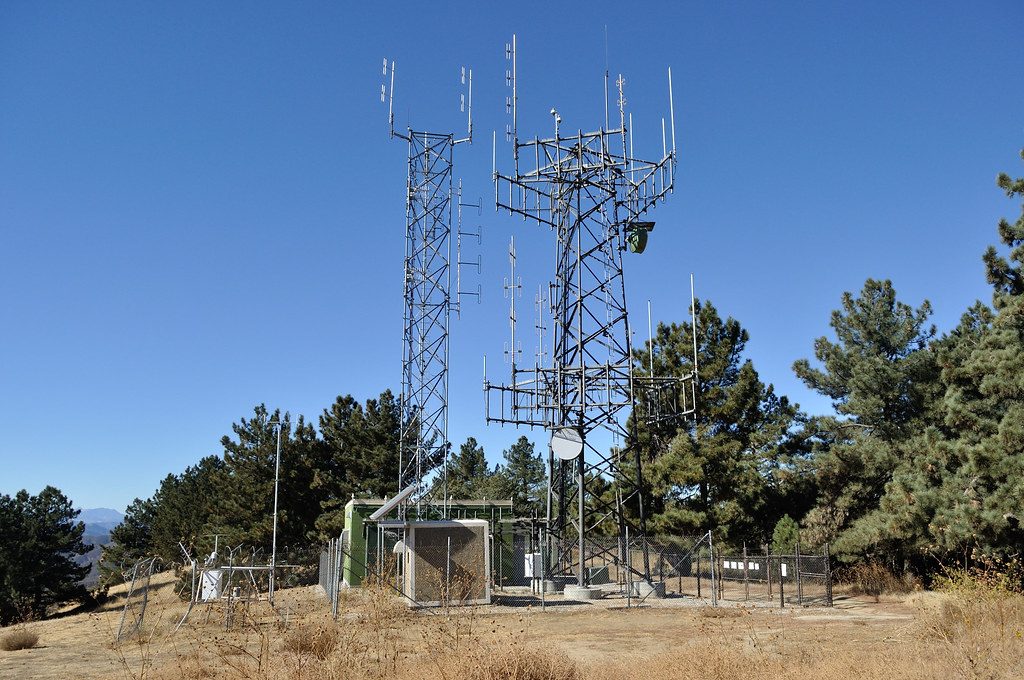
Communications towers at a site
When a site goes down, two clicks give you the list of affected customers.
02 · Technical and network

The network, with names
and surnames

Every connection knows which antenna it comes off, with which IP, which RADIUS profile and which CPE is installed, down to its serial number. And you can warn customers before they call.

  • ConnectionsGuided activation, advanced search, bulk changes, prepaid, IP and MAC history, and a status log.
  • ProvisioningWrites straight to MikroTik, OLT, RADIUS and ACS when a service is activated, changed or suspended.
  • MonitoringTraffic per interface, availability, historical graphs and usage per customer.
  • BackupsAutomatic backup of every router's configuration, with a diff between versions.

A living inventory

Routers, switches, sites, point-to-point links and access points, with their IP, their model and which tower they belong to.

IP addressing

Subnets, RADIUS and MikroTik pools, static IPs, reservation and release on cancellation.

Signals and planning

Signal management per customer and frequency planning per sector, so you don't interfere with yourself.

Alerts and logs

Site outages, signal thresholds, network log and syslog. The alert opens a ticket and notifies.

The field technician's console

The install is done by whoever
is up the poleNew

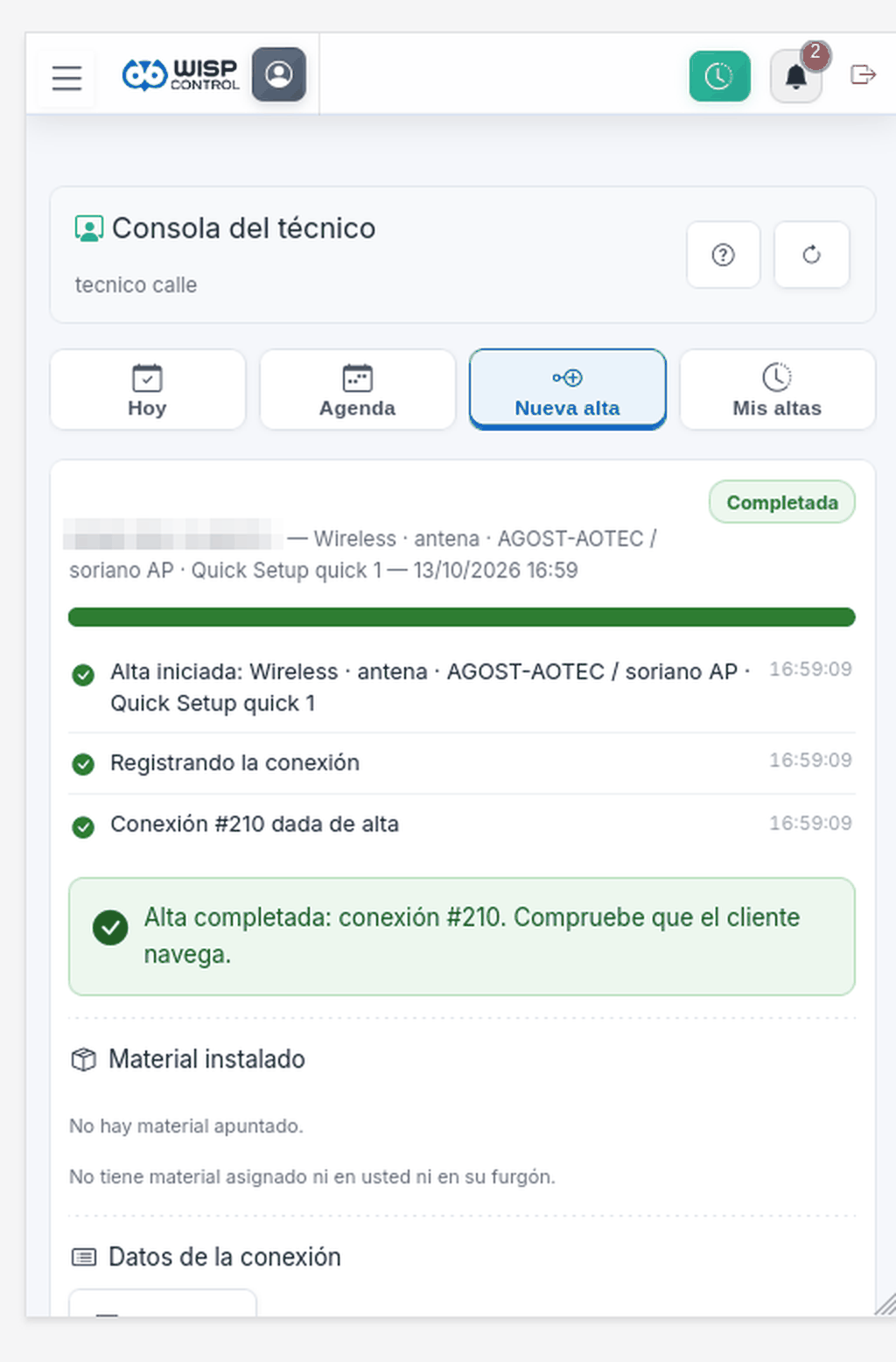
A separate screen, in kiosk mode, for the technician and their phone: the day's jobs, the week's diary with appointments they can move, and the install. They do not see the rest of the system.
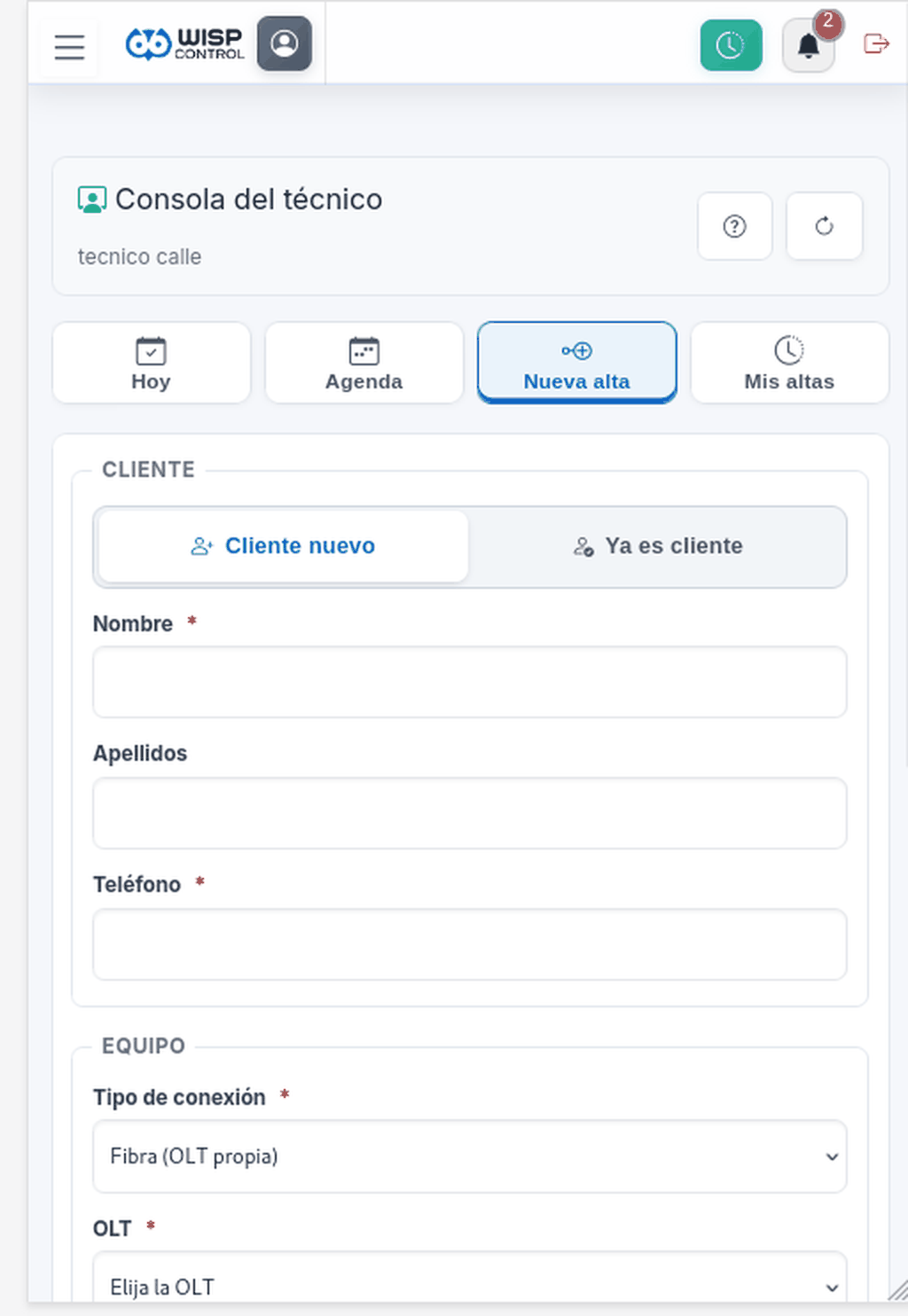
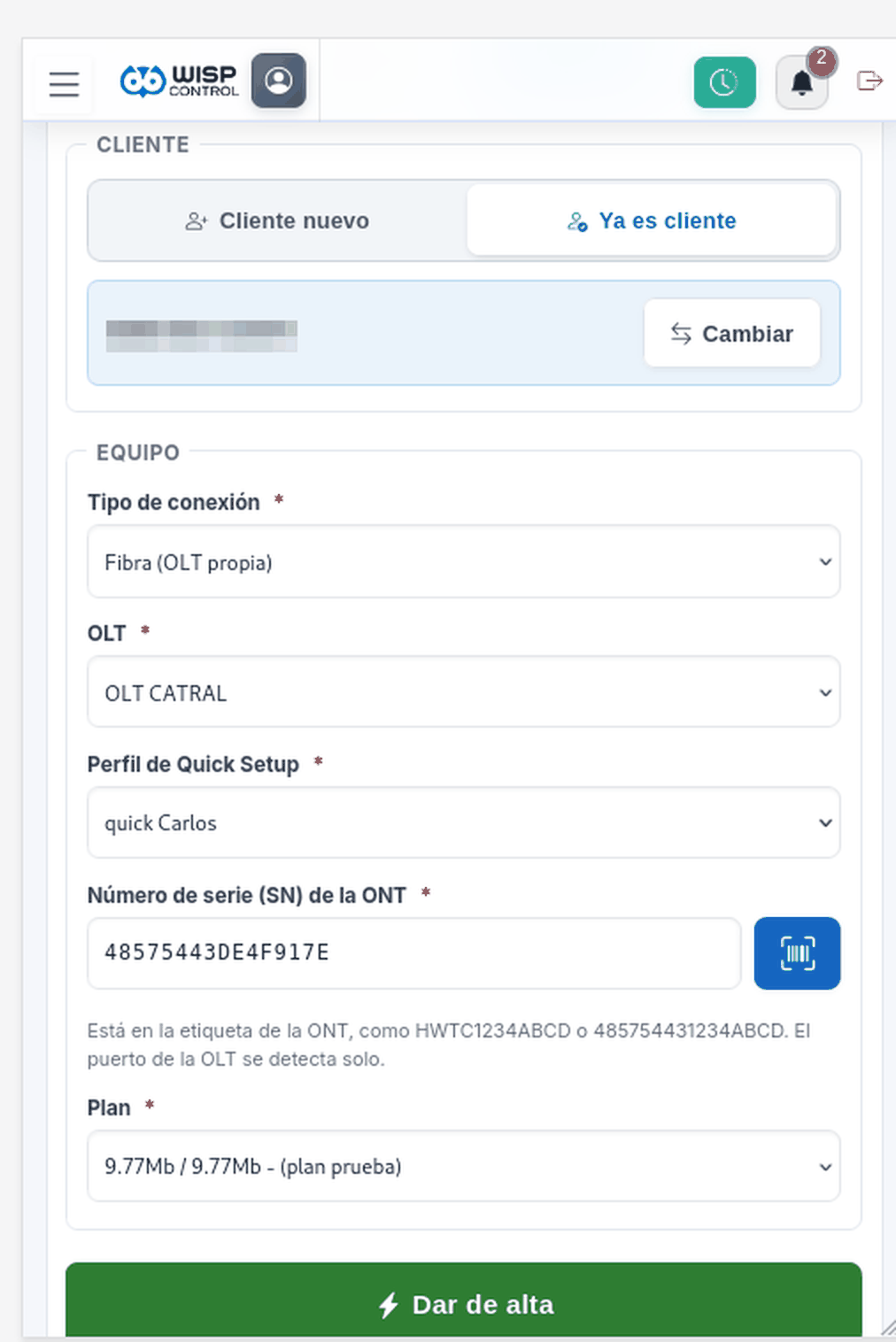
The technician's console on the phone: Today, Diary, New install and My installs tabs, with the customer and equipment form
Opens the install and chooses whether the customer already exists or creates them on the spot.
The form filled in: OLT, Quick Setup profile, ONT serial number and plan, with the install button
Types the ONT serial number — or reads it with the camera. The OLT port is detected on its own.
Install completed: the steps in green and the notice that the connection is now live
And the system does the rest: the ONT on the OLT, the VLANs, the user, the ACS and the connection created.
03 · Fibre optics · GeoRed

Your FTTH plant stops
living inside a KMZ file

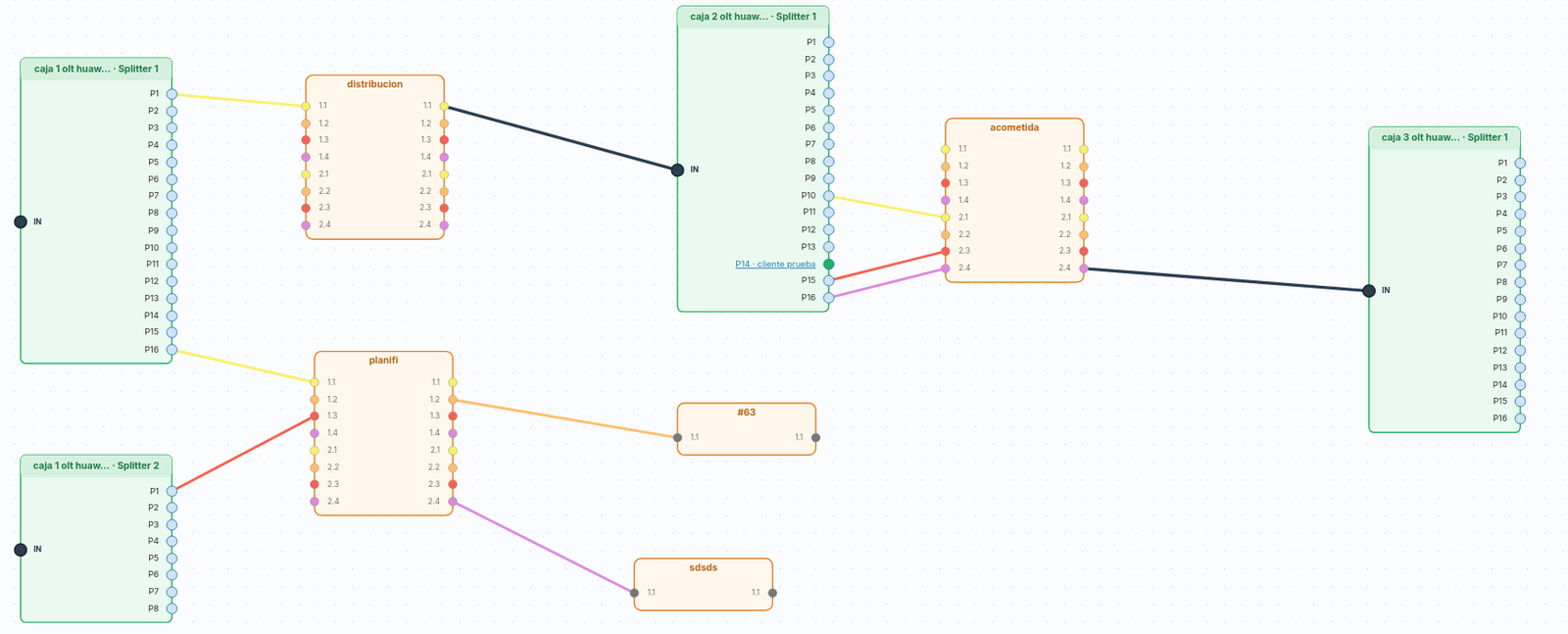
GeoRed is not a map with customers on it. It is the network: the OLT, the trunk, the splices, the splitters, every distribution box with its ports and the customer hanging off port 4. If you open a box to add someone, the system already knows whether there is room.
  • ElementsOLTs, chambers, manholes, poles, splices, splitters, distribution boxes and drops, each with its own record and photos.
  • RoutingThe cable runs where it actually runs: real distances, fibre type, number of strands and accumulated loss down to the customer.
  • KMZ importThe engineer's project goes in as it is and becomes network. In batches, and if something goes wrong the whole batch is undone.
  • Coverage and outagesSales can check whether an address has fibre; a trunk cut flags every customer hanging off it.
geored / strand diagram
Strand diagram: boxes, splitters and ports joined by the coloured fibres, with the customer on port 14
The real strand diagram: which fibre from which cable goes into which port of which splitter, and which one each customer hangs off.
connection / signal history
Optical signal history for a connection: receive, transmit and power over time, in a table and a graph
Every customer's optical signal, kept over time. When someone says «it's been bad since Thursday», this shows whether that's true and since when.
04 · Warehouse

Every device has
a serial number and an owner

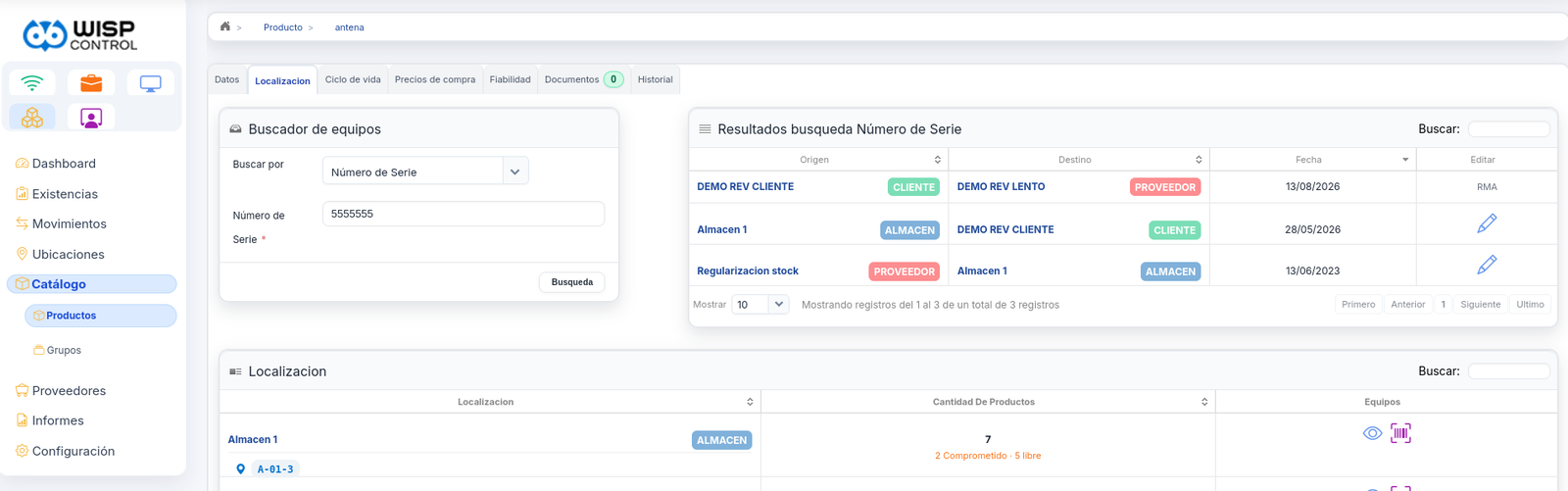
The warehouse in version 5.4 tracks the physical unit, not the pile. You know which specific ONT came in on which order, which van it travelled in, whose home it is in and whether it came back when they cancelled.
  • StockStock per warehouse, van and technician, showing what is committed in unconfirmed transfers and what is genuinely free.
  • TransfersMovement between locations picking the device by serial number or MAC, with a PDF delivery note and signature.
  • PurchasesPurchase orders to the supplier as PDF, agreed price against last price paid, and a comparison across suppliers.
  • Labels and stock countsPrinting with barcode or QR, for the product or for each unit, and continuous scanning during stocktakes.
  • VehiclesVan paperwork, reminders for the MOT, insurance and service, mileage, and automatic replenishment to minimum levels.
  • Write-offs and RMAsA reason for every write-off, a warning if the device was still under warranty, and equipment never recovered from cancelled customers.
warehouse / product / location
Search by serial number with the device's history and stock by location
One serial number and its whole life: purchase, installation at a customer and RMA.
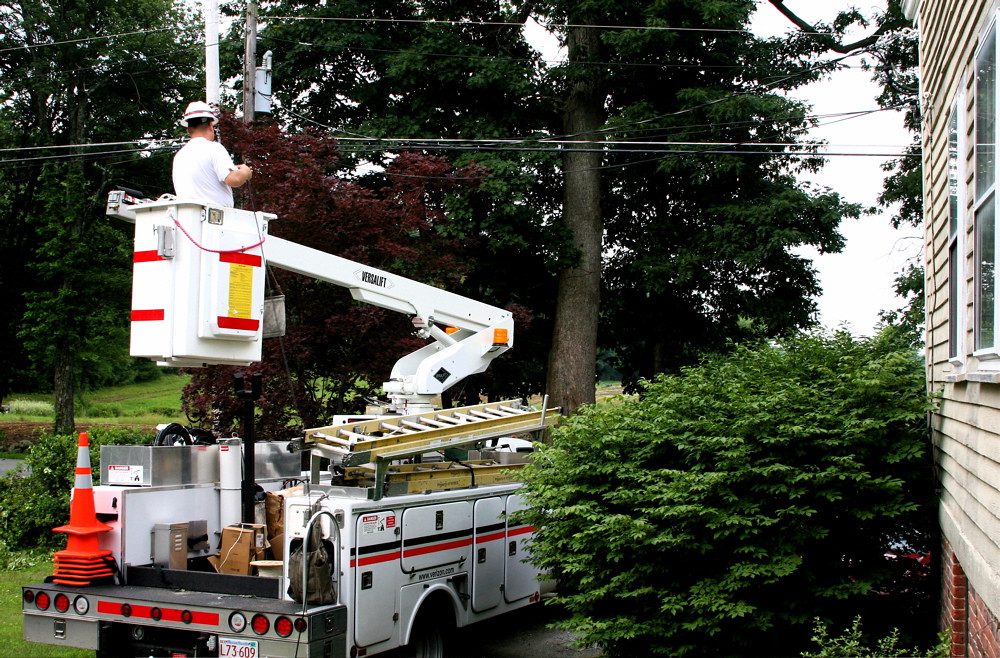
Technician working from a cherry picker
The unrecovered equipment report tells you how much money you have scattered around out there.
View of a city with a communications tower
Coverage is measured on the map before anyone promises anything.
05 · Sales and commissions

Selling is a process
as well

The sales rep works on the same database as administration. When they close a sale they do not fill in a form for someone else to retype: the lead becomes a customer with their contract, their plan and their installation appointment.

And commissions work themselves out from what each person has brought in, on their own terms: per sale, per contract term met and per product type. Out come settlements by period, targets and a leaderboard that, funnily enough, people do look at.
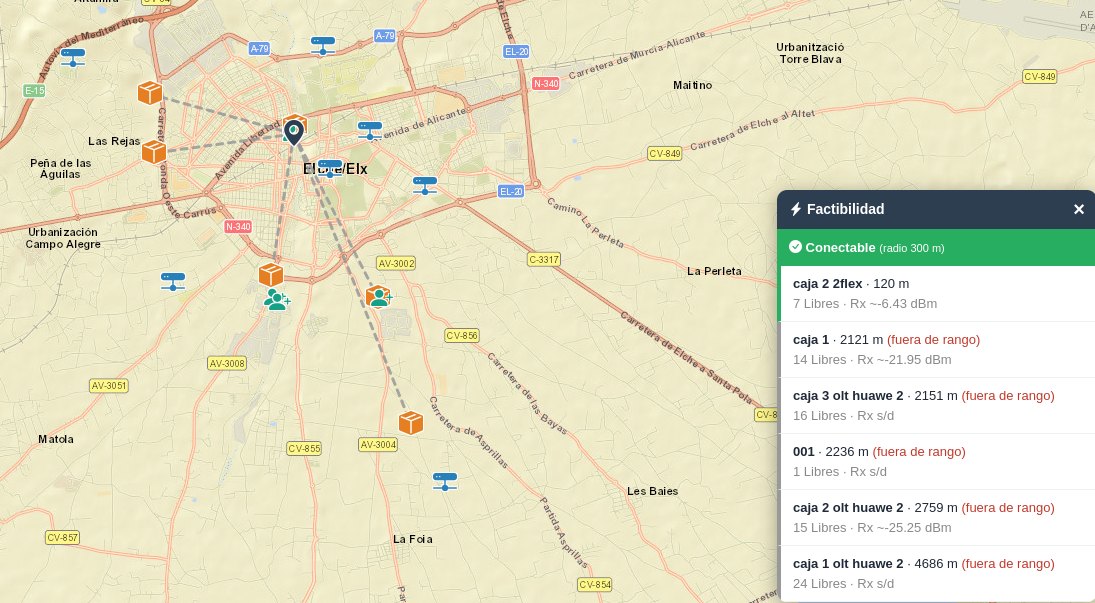
sales / feasibility
Feasibility study on the map: boxes sorted by distance, with the free ports and the estimated signal of each
The boxes sorted by distance, with the free ports and the estimated signal of each. Connectable or not, and why.

Leads

Who called, where they came from, who is handling them and where it stands, with a reminder so the lead doesn't go cold.

Coverage

Anyone outside goes onto the list of leads without coverage, for when the fibre arrives.

Customer base

Accounts assigned per rep, visit calendar and retention follow-up.

Commissions

Generated per sale and per contract term, with settlements, targets and a sales leaderboard.

06 · Telephony and TV

Fibre, mobile and TV
on a single bill

Nine MVNOs connected, the Zapi TV platform integrated, automatic CDR import and rating with the cost right next to the price. The customer gets one document and pays once.
  • CarriersAire Networks, Cablemóvil, Finetwork, Lemonvil, OnMóvil, Avatel, Likes, Silbo and Telecom Boutique, plus a generic API or SFTP connection.
  • CDRScheduled download, detection of missing files and duplicate control.
  • RatingBy destination and time band, with bundles, included minutes and overages. Wholesale cost against retail price, line by line.
  • LinesActivations, cancellations, number porting, plan changes and SIM status without leaving the customer record.
  • Mobile line consoleNewThe line exactly as it is at the carrier: tariff, voice, SMS and data usage with what is left, bundles and open cases. From there you change bars, roaming, diverts and the spending limit, with Cablemóvil, OnMóvil, Aire Networks and Lemonvil.
  • Cost and margin per lineWhat the carrier charges you for that number against what you invoice the customer, and a comparator that goes through all of a customer's lines and adds up both figures.
  • Shared bundlesNewA pot of minutes that several of the same customer's lines use between them, even on different contracts. Each line's own bundle is used first, then the shared pot.
  • Porting in batchesNewInstalls and number porting for many lines at once. They do not all go out together: they go one by one waiting for the carrier's reply, with tracking and a retry for the ones that fail.
  • Television: Zapi, +Media and ModernTVSigning up creates the subscriber on the platform, adds their packages and registers their televisions. TV is managed from the customer's record, the overdue cut-off reaches it too, and it all comes out on the same bill.
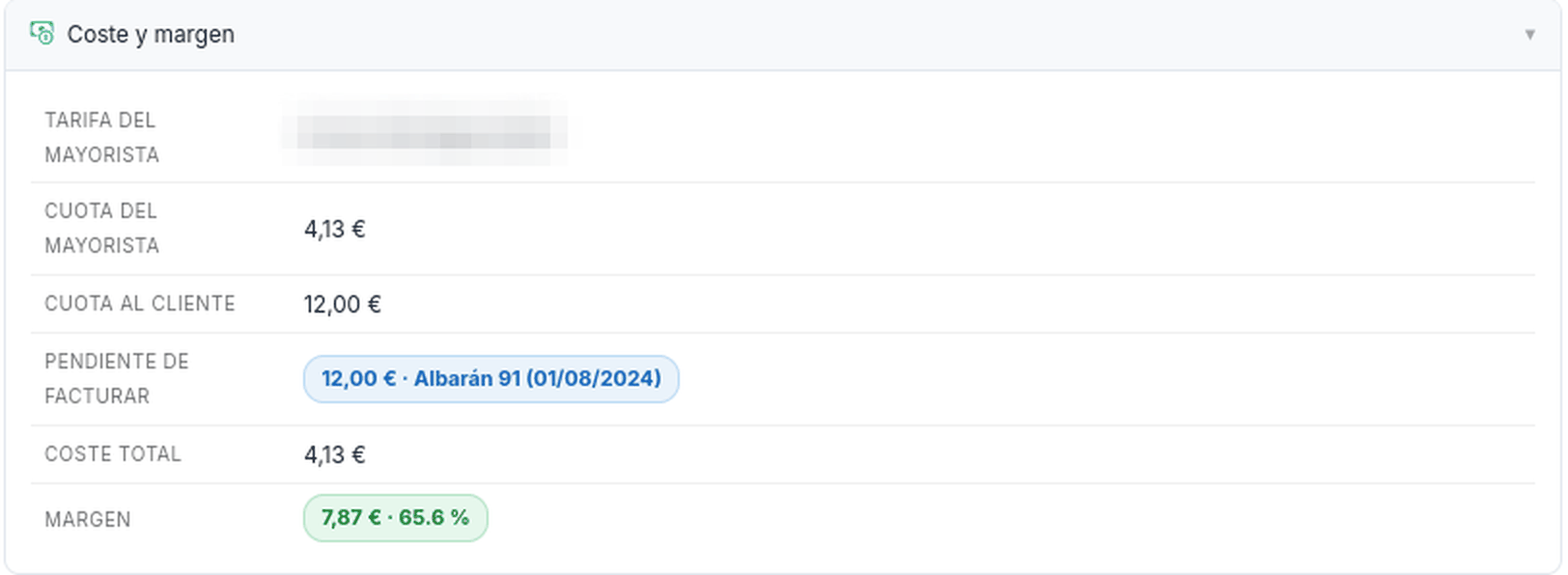
Cost and margin of a mobile line: wholesale fee, customer fee, what is pending invoicing, total cost and the margin in euros and as a percentage
Line by line: what the wholesaler charges you against what you invoice the customer. If a line is costing you more than it pays, it shows up here before it shows up at the bank.
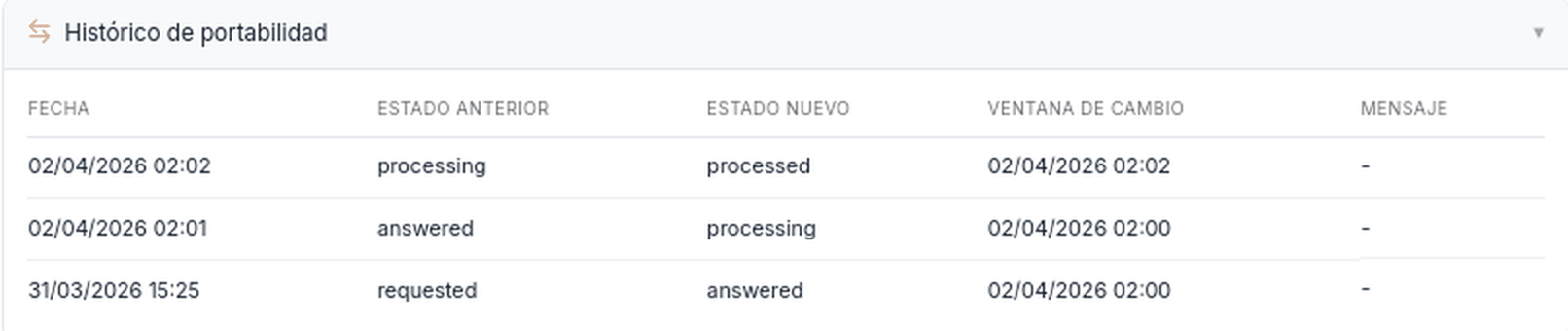
Porting history of a line: date, previous status, new status and change window at each step
And the porting, step by step with its change window, without going into the carrier's panel to see how far along it is.
See the carrier table
Telephony reconciliation August
CarrierLinesCostRetail
Aire Networks4123 984 €6 118 €
Finetwork1281 216 €1 792 €
Lemonvil54497 €702 €
Landline · CDR—311 €598 €
Margin for the month+3 202 € · 34,4 %
07 · Tickets and Call Centre

From «my internet is down»
to the signed work order

A ticket is not just a ticket: it carries the customer, the device, the site, the assigned technician, the appointment, the materials used and the work order the customer signs at the end.

Step 1

Intake

By phone, from the customer portal, or raised on its own by a network alert.

Step 2

Assignment

To the area technician, with their calendar, their holidays and their appointments already loaded.

Step 3

Work order

Work done, materials taken from the van and the customer's signature on the PDF.

Step 4

Closing

It is invoiced if it was chargeable, the stock is deducted and it stays in the customer's history.
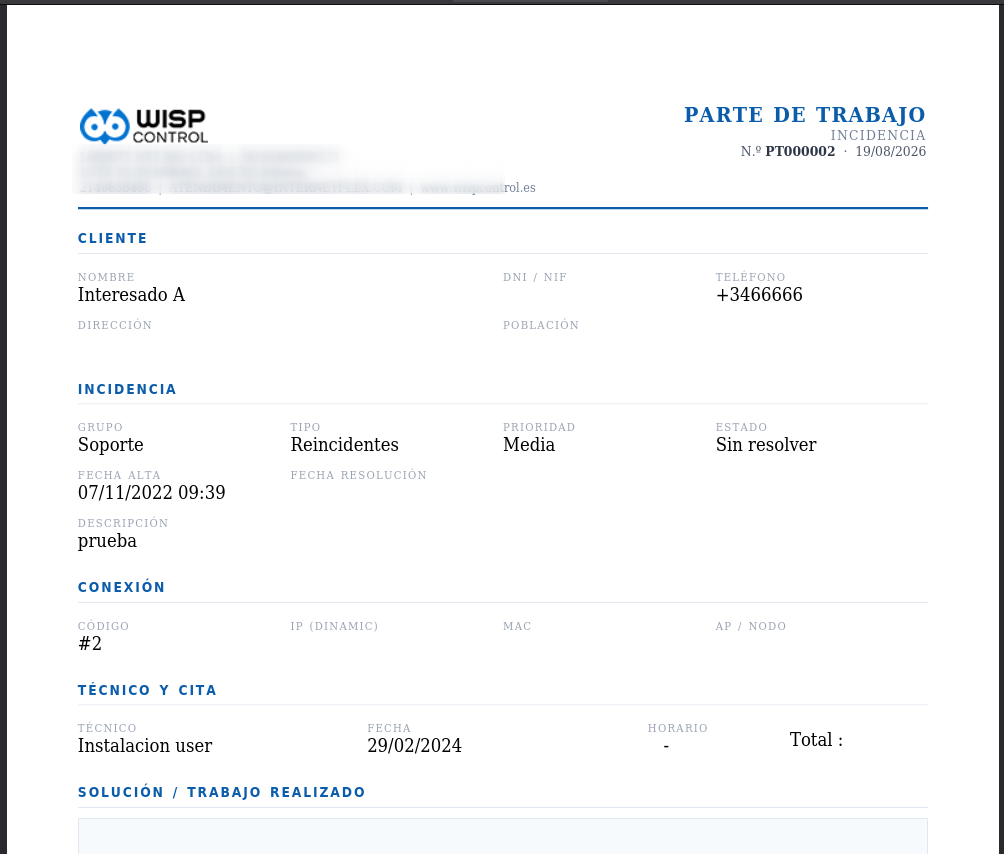
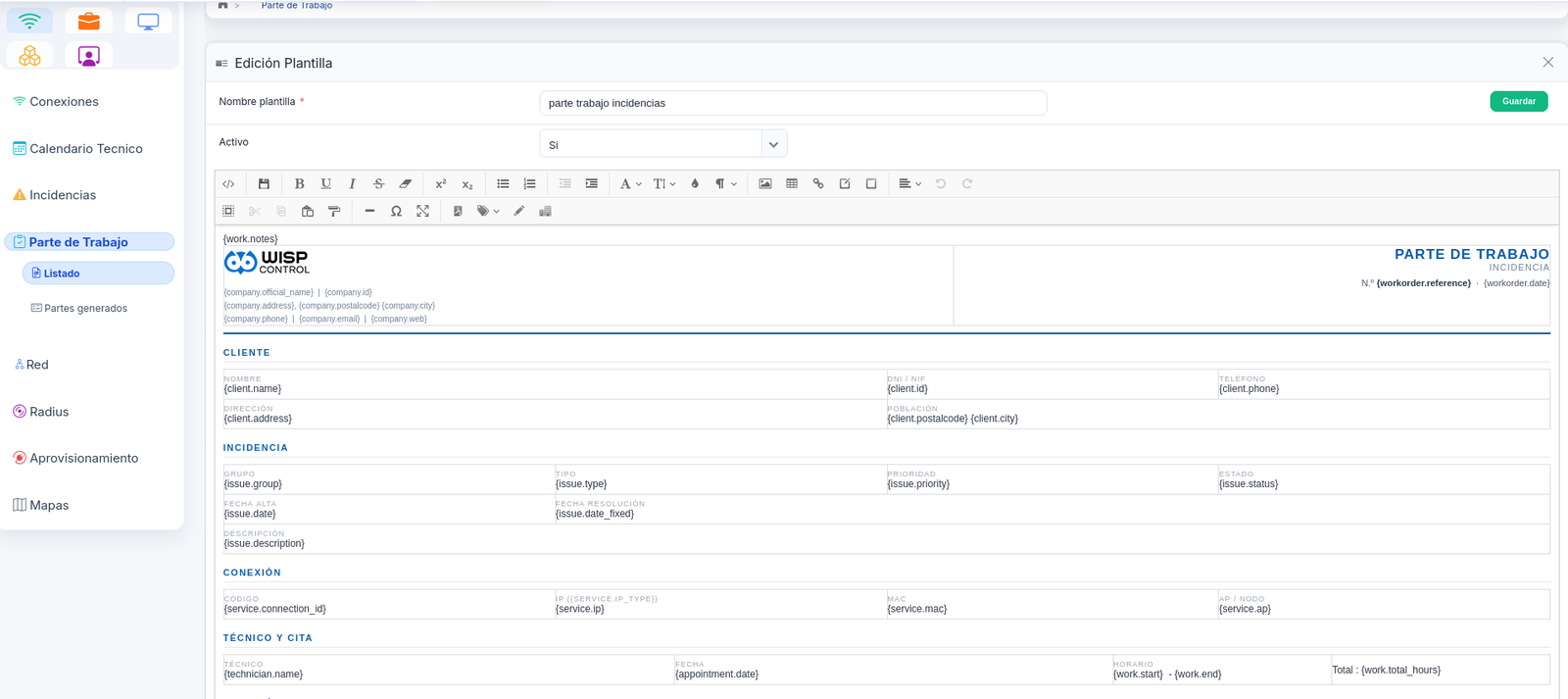
work order · PDF
Work order as PDF: customer details, the ticket, the connection, the technician and the appointment, plus space for the fix
The work order the technician takes with them and the customer signs at the end.
work order / template
Editor for the work order template, with the dynamic fields in braces
And the template is yours: you edit it like a document and the data fills itself in through the fields in braces.

A console for whoever answers the phone

A single support screen: you find the customer while they are talking, see whether they are suspended for non-payment, whether there is an open outage in their area, when they last paid, and you open the ticket without navigating six menus. Designed to run in kiosk mode, with no access to the rest of the system.

  • The moment you pick upCustomer identified by phone number, with their status and services on screen.
  • Area outageIf the site is down, the agent sees it before opening a duplicate ticket.
  • ActionsReboot the CPE, check the signal, book an appointment and take an outstanding payment.
08 · System and team

The boring part, sorted

An operator's ERP also ends up being where people clock in, where holidays are requested and where it is recorded who touched what. It is all in here, with the same user and the same permissions.

Users and permissions

Roles per module and per screen. Multi-company with its own invoice series, banks and logos.

A dashboard you lay out

Each user places their widgets, resizes them and hides the ones they don't use. The layout is saved for them: the dashboard of the person doing the billing needn't look anything like the one of the person climbing a tower.

Time tracking

Clock-in with breaks, corrections, shifts, a signed monthly record and holidays. It meets working-time recording rules.

Personal diary

Your own private tasks, with repeats and reminders, that show on the team calendar as «busy».

Notifications

Bulk and automatic, by email, SMS and WhatsApp, with templates per language and a delivery log.

Statistics

Sign-ups over the last twelve months, traffic, usage, the customers with the most tickets and performance per technician.

Our own API

So your website can create contracts and your tools can query customers, invoices and tickets without typing anything twice. With documentation and hands-on help.

Seven languages

Spanish, Catalan, English, French, Italian, Portuguese and Latin American Spanish. Notifications go out in the customer's language.

09 · Customer portal and app

Your customers serve
themselves

A web portal with your domain and your logo, and your own app for iPhone and Android. At eleven at night or on a Saturday: what used to come in by phone the customer solves from their mobile, and it lands in WispControl already classified and with the customer identified.

  • Pay their invoicesThey see what they owe and pay it by card or Bizum. The payment reconciles itself and the suspension is lifted instantly.
  • Check their usageThis month's data, calls, contracted speed and a traffic graph. Fewer arguments about the bill.
Your app onApp Store Your app onGoogle Play And alsoPortal web

It is not a WispControl app with your logo inside: it is your app, published in the stores under your operator's name. Your customers search for your brand and download yours.
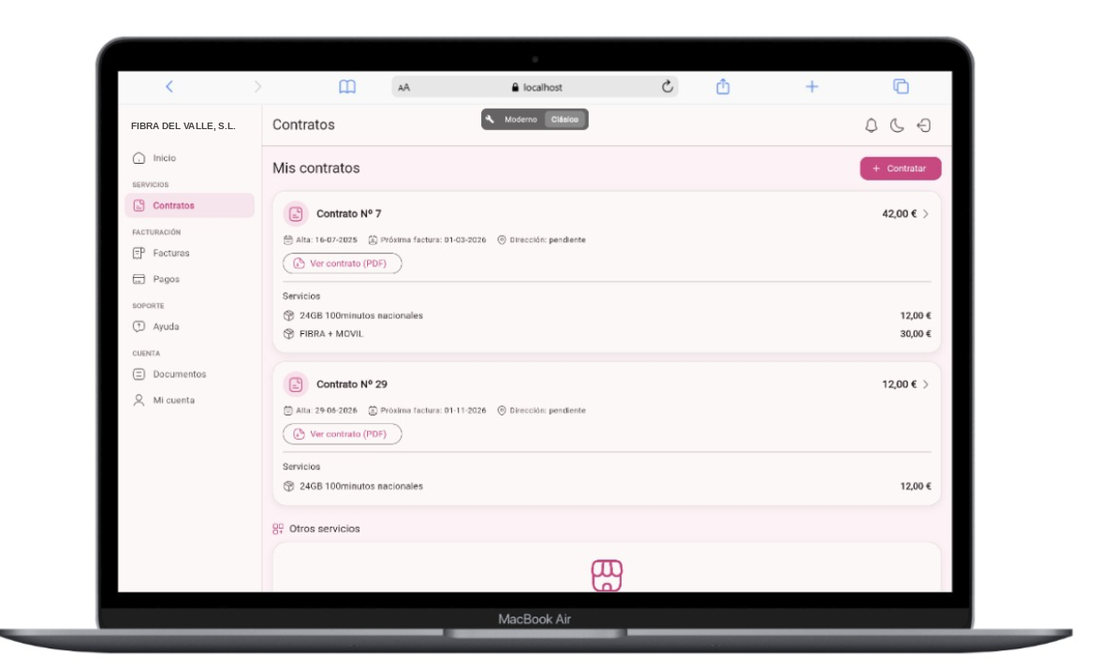
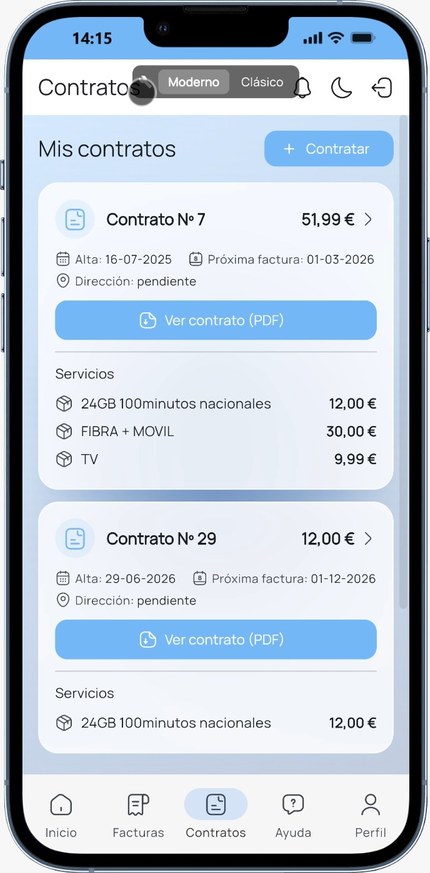
Customer portal with their contracts and services
Customer app: contracts with fibre, mobile and TV

With your brand, your colours and your plans. The customer never sees the WispControl name.

10 · Field collection

Whoever collects on the street
carries the system tooNew

A role of its own, Collector, with its own console and nothing else: they only see the customers in the zones you assign them. They open the day's round, collect, and what they take in is reconciled to the cent when they hand the money over.

The day's round

The customers in their zones who owe something, sorted by debt, by GPS proximity or in their own order. They collect one bill or all of the customer's.

How much they can carry

Three brakes: by amount, with a warning before the block; by how old the oldest undelivered collection is; and by not having closed the previous day. If they get stuck, they request a top-up and you approve it with an expiry.

Cash-up and handover

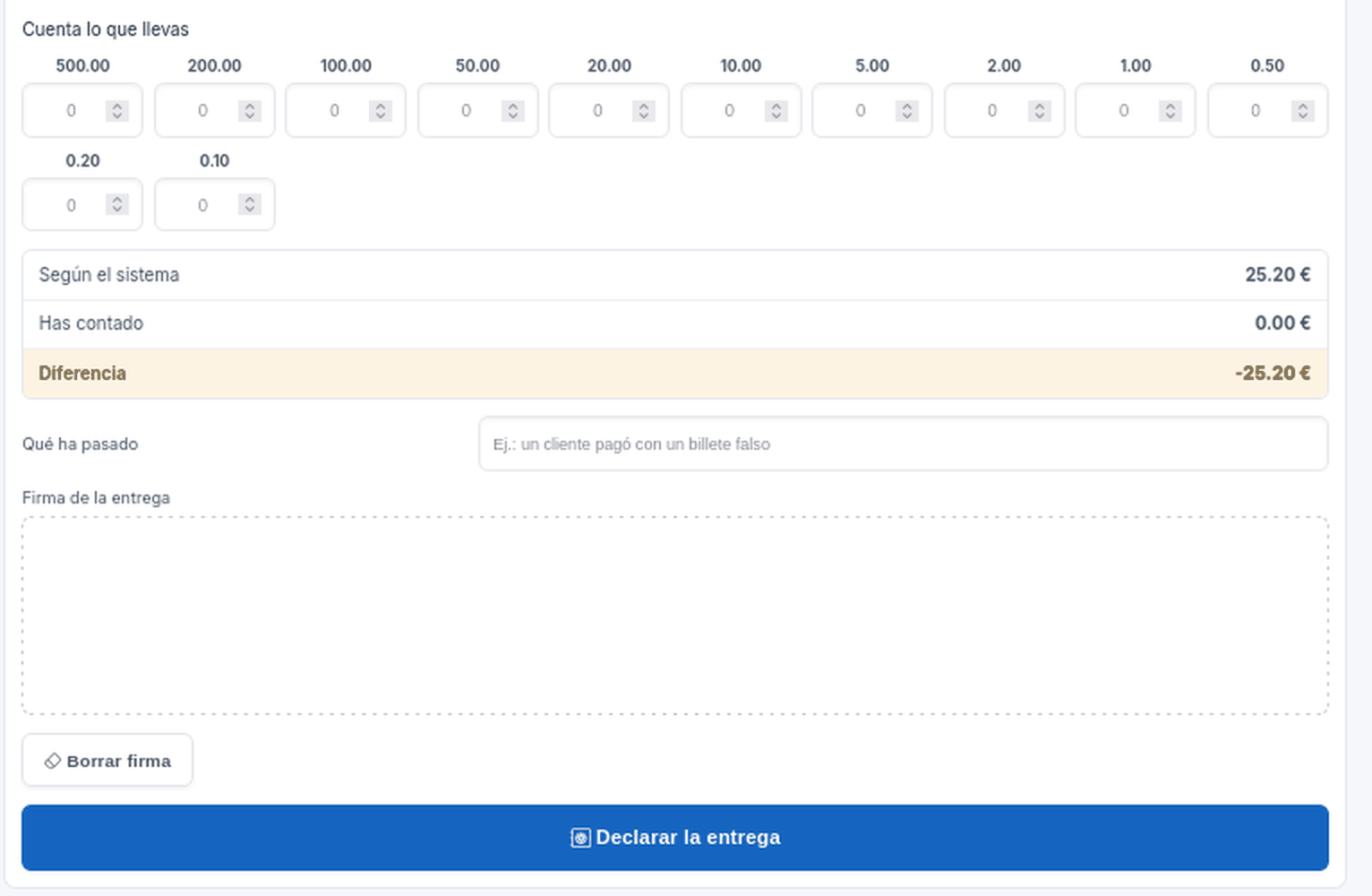
They count notes and coins, sign on screen and declare the handover. The supervisor validates or rejects it, and the money stops counting as theirs.

That the collection is where it says

Every collection saves its position and the distance to the customer. The ones that land far away or with no position are flagged, and each collector has a reliability score.

The customer, forewarned

Advance notice of the visit by e-mail, SMS or WhatsApp, with a time window and a daily cap. And a receipt when the collection is recorded, with its proof of payment.

Commission and payment points

Commission on collection as a percentage or a fixed amount, and only on recovered arrears if you want. Plus shops or third parties that collect for you with prepaid credit.

Collecting an overdue bill closes the arrears, withdraws the scheduled cut-off and brings the service back, just as if it had been collected from the office.
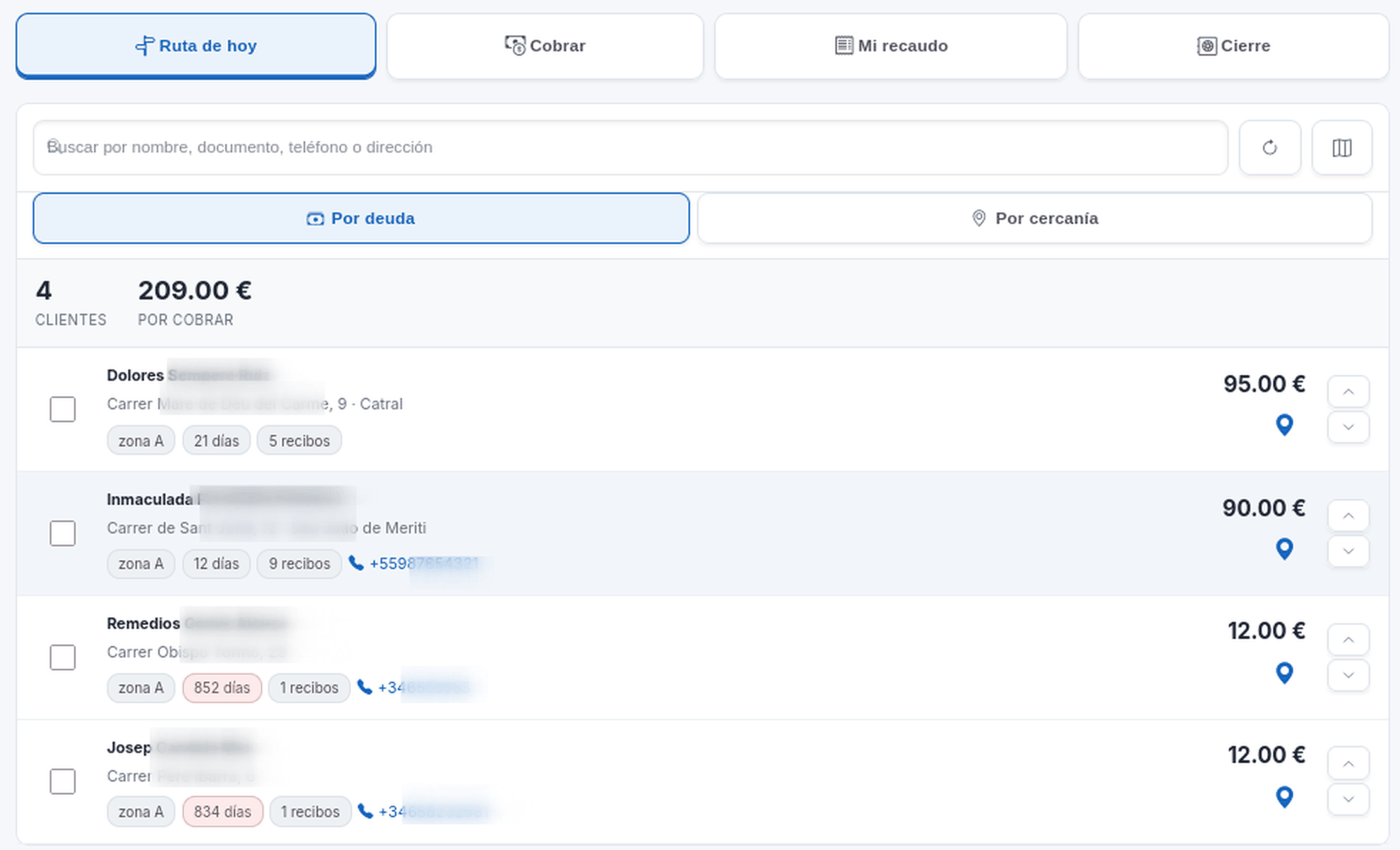
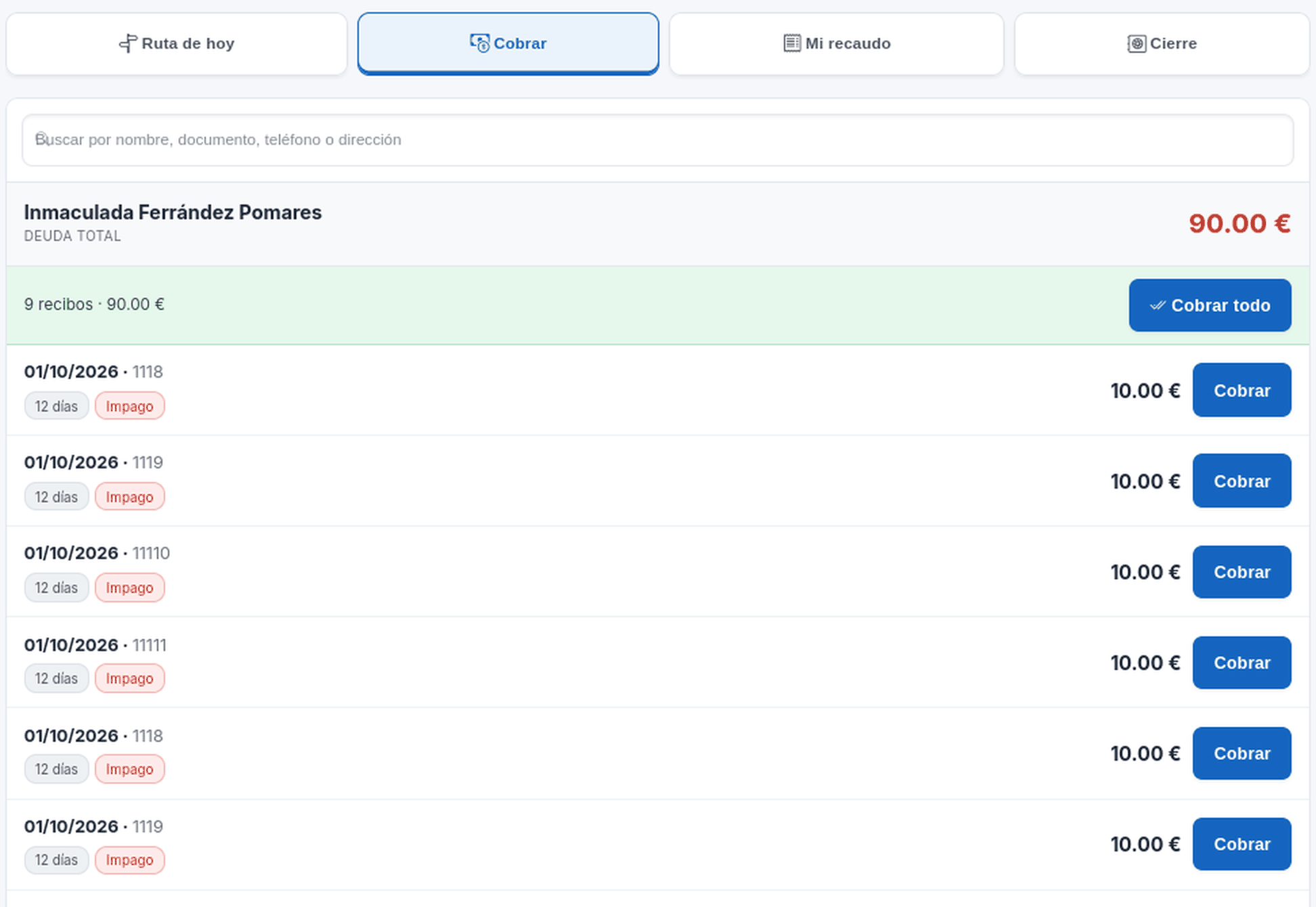
your-operator.wispcontrol.com / collector
The collector's round for today: four customers with their address, how old the debt is, the number of bills and the amount, sorted by debt or by proximity
The day's round: who to go to, how much they owe and since when. The proximity button reorders it by what is on the way.
your-operator.wispcontrol.com / collector / collect
Collection screen: the customer's bills with their date, how long they have been due and the overdue label, each with its own collect button and one to collect them all
At the door: one, several or all of their bills. Each with how long it has gone unpaid.
Cash-up: counting by note and coin denominations, what the system says against what was counted, the difference, a field to explain it and the signature box
And at the end of the day, the cash-up: they count notes and coins, the system tells them whether it balances, they explain the difference if there is one and sign the handover on screen.
11 · NOC

The network watched on its ownNew

The NOC takes the equipment you already have on the system and checks it by itself. It shows outages with the customers behind them and what they bill, but above all it shows what has not broken yet: the fibre going bad, the box running out of ports and the uplink heading for saturation.

And it settles two pieces of paperwork that cost you an afternoon: the SLA report and identifying a subscriber by IP and port under CGNAT, with its legal report.
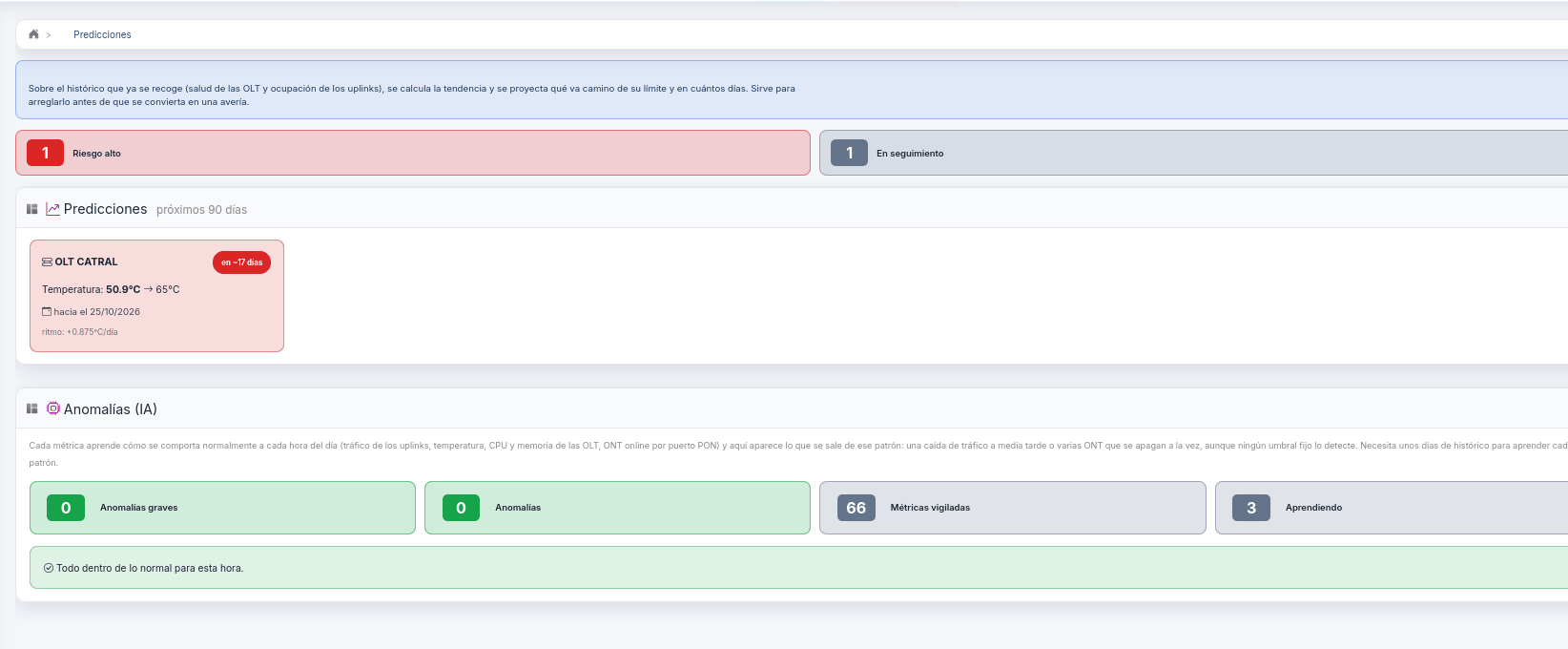
NOC predictions screen: OLTs at risk from temperature and uplinks with their usage, each with the estimated date it will hit its limit

Eleven blocks written
on a single page

In half an hour we'll show you the three that matter to you, with data like yours. No PowerPoint.

Book a demo See pricing